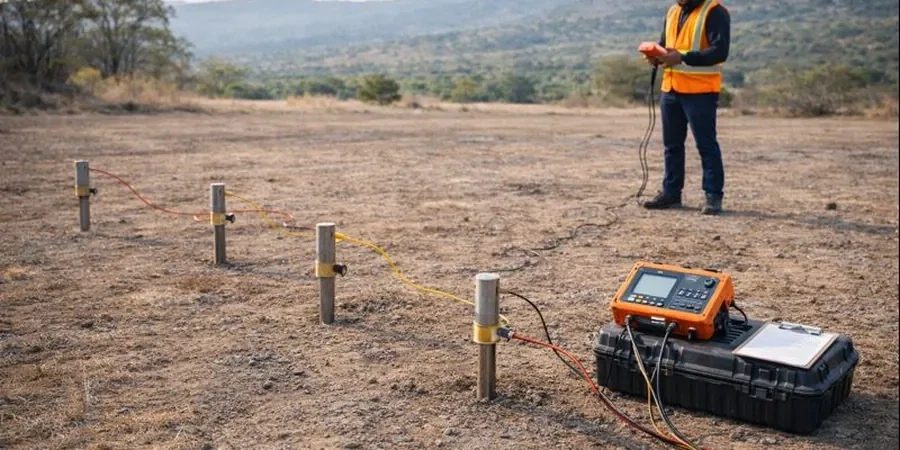
The resistivity meter we mobilize across Hialeah is a multi-electrode system with a 200 W transmitter and a switching unit that manages up to 72 electrodes in a single spread. Because Hialeah sits on the Miami Limestone formation—a Pleistocene oolitic facies riddled with dissolution features—the electrode coupling can shift dramatically within a few meters. Our field crew keeps a spray bottle of salt water and bentonite slurry on hand for dry surface conditions common in the city’s western industrial corridors. Before laying out the cable, we always check for underground utilities along West 20th Avenue and near the Hialeah Park race track, where decades of irrigation have created a perched freshwater lens that affects the resistivity contrast. For deeper targets, we switch to resistivity arrays with 5-meter electrode spacing, which lets us resolve the contact between the Fort Thompson Formation and the underlying Tamiami Formation at depths of 15 to 25 meters.
A tight limestone cavity 10 meters down can appear as a 300-ohm-m anomaly on a dipole-dipole pseudosection, but only a VES sounding will confirm whether the void is air-filled or clay-plugged.
Scope of work in Hialeah
Typical technical challenges in Hialeah
The subtropical rainfall pattern in Hialeah—averaging 60 inches per year with a pronounced June–October wet season—creates a seasonal resistivity swing that can mask underlying anomalies. A VES sounding run in March, when the water table sits lower, will often show a resistive cap above the limestone; the same sounding in September, after the aquifer has recharged, may compress that cap into a thin unsaturated zone less than a meter thick. For foundation projects near the Hialeah Canal and along the Miami River tributaries, this seasonal fluctuation matters because it changes the interpreted depth to competent rock by as much as 2 meters. We time critical surveys for early spring or late fall whenever possible, and we log the rainfall history of the preceding 72 hours on every field sheet. In flood-prone zones east of Red Road, where the Biscayne Aquifer is essentially unconfined, we also use cpt-test pore-pressure dissipation data to constrain the groundwater depth for the resistivity model.
Our services
In Hialeah, our field crews perform two complementary resistivity services, each supported by in-house data processing conducted at our Miami-Dade laboratory.
2D Electrical Resistivity Tomography (ERT)
A multi-electrode array, either towed or planted along a transect, is ideal for mapping lateral variations in limestone integrity across a proposed building area. The array configuration is selected based on the target: the Wenner array for vertical resolution, and the dipole-dipole array for horizontal sensitivity to voids.
Vertical Electrical Sounding (VES)
This is a single-location, expanding-spread survey that generates a 1D resistivity-versus-depth curve. In Hialeah, we frequently employ it to determine the depth of the Miami Limestone–Fort Thompson contact and to estimate the thickness of the overlying sand and organic layer prior to footing design.
Common questions
How deep can a VES survey reach in Hialeah’s limestone?
Using our 200 W transmitter and a maximum Schlumberger AB/2 spacing of 100 meters, we typically achieve investigation depths of 30 to 40 meters within the Miami Limestone. Actual penetration depth hinges on resistivity contrast; in saturated zones near the Biscayne Aquifer, signal attenuation increases, limiting useful resolution to about 25 meters. For deeper targets, we combine the VES with a seismic refraction line to independently constrain bedrock velocity.
What does an electrical resistivity test in Hialeah cost?
A standard single-site VES sounding or a short 2D profile (up to 100 meters of spread length) costs between US$550 and US$910, which includes mobilization within Hialeah, data acquisition, inversion processing, and a signed report with interpreted cross-sections. Longer ERT lines or surveys needing multiple soundings are priced per linear meter after reviewing site access and surface conditions.
Can resistivity distinguish between an air-filled cavity and a water-filled cavity?
Yes, that is a key reason we apply this method in Hialeah's karst terrain. An air-filled void within the Miami Limestone manifests as a high-resistivity anomaly, often exceeding 600 ohm-m, since air is an electrical insulator. A water- or clay-filled cavity typically registers below 100 ohm-m. The anomaly's shape in the inverted section and the VES curve type—whether H-type or K-type—provide geophysical clues for interpreting fill material prior to drilling confirmation.
How long does a resistivity survey take on a typical Hialeah lot?
A single VES sounding with four to five expanding-spread measurements takes our two-person crew roughly 45 minutes for setup and acquisition, plus another 15 minutes for electrode retrieval. A 200-foot 2D ERT line using 48 electrodes and a Wenner-Schlumberger sequence requires about 90 minutes of acquisition time. On a typical working day, we can complete two to three lines, provided the site is free of dense vegetation and the surface is accessible for cable layout.