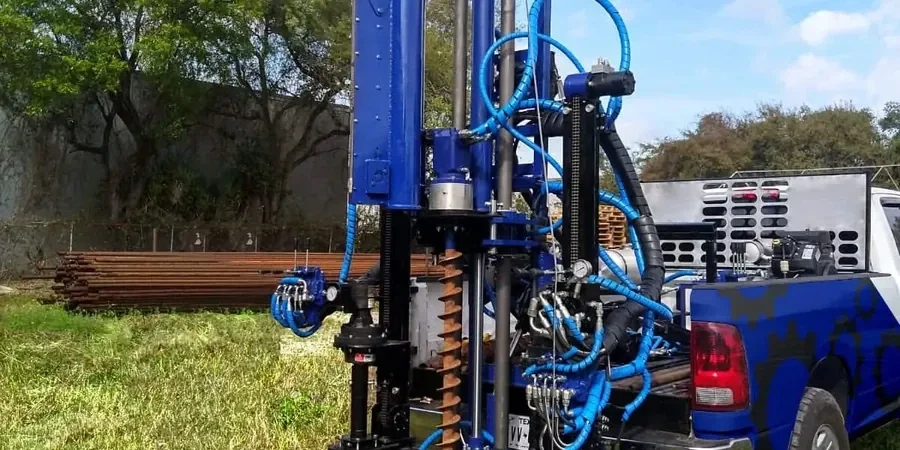
Hialeah sits on a limestone ridge just a few feet above the water table, and that changes everything about how we drill. You hit Miami oolite one minute, then loose sand or organic silt the next. For any structure taller than two stories, guessing the stratigraphy is a gamble. We run the SPT drilling in Hialeah to ASTM D1586, recovering split-spoon samples every 2.5 or 5 feet. The N-values tell us whether we are in dense caprock or in softer material that will settle. In a city with 223,000 residents packed into 23 square miles, every new development sits on ground that has already been reworked, filled, or drained. Knowing what lies beneath the fill is not optional—it is the starting point.
In Hialeah, the difference between loose fill and dense limestone can be less than two feet. SPT N-values catch that transition.
Scope of work in Hialeah
Typical technical challenges in Hialeah
The most common mistake we see in Hialeah is stopping the boring too early. A contractor hits limestone at 12 feet, calls it bearing stratum, and pours the footing. Then the rainy season arrives and the water table rises into the overlying sand, triggering settlement in the loose layer they ignored. We have walked onto sites where a 4-story apartment block showed 2-inch differential settlement because the SPT investigation stopped at 15 feet while the real compressible layer sat at 22 feet. Hialeah’s high water table—often less than 5 feet below grade—also causes heaving inside the casing if we do not keep the hole full of water. Our crew knows the local hydrogeology well enough to anticipate this and maintain hole stability throughout the test.
Our services
Every SPT program in Hialeah is designed around the specific structure and the site’s history. Below are the core services we provide as part of a standard penetration test investigation.
SPT Borehole Drilling
Mud-rotary or hollow-stem auger drilling to target depth with SPT sampling at prescribed intervals. We log recovery, blow count, and water level.
N-Value Correction & Energy Calibration
Raw N-values corrected for overburden pressure and hammer energy ratio. Our safety hammer is calibrated regularly to ensure ER₆₀ consistency.
Laboratory Index Testing
Grain size analysis and Atterberg limits on recovered SPT samples to confirm field classification and support foundation design parameters.
Bearing Capacity & Settlement Estimates
We deliver a factual report with SPT N₆₀ profiles and, when requested, preliminary bearing capacity and settlement calculations for shallow and deep foundations.
Common questions
How many SPT boreholes do I need for a small commercial building in Hialeah?
For a single-story commercial building under about 5,000 square feet, two to three boreholes spaced across the footprint usually satisfy IBC requirements. If the site is on the eastern side of Hialeah near the old wetlands, we may recommend an additional boring to check for deeper organic layers.
How much does an SPT investigation cost for a typical Hialeah lot?
For a standard residential or small commercial lot, an SPT investigation with two boreholes to 30 feet typically runs between US$570 and US$700 per hole, depending on access and soil conditions. Deeper borings or difficult access may adjust the final figure.
How long does it take to get the SPT report after drilling?
You receive the field logs the same day we complete the boreholes. The final report with laboratory index tests and corrected N₆₀ values is usually ready in four to five business days.