In Hialeah, a seven-story mixed-use development near Palm Avenue encountered a familiar issue: the geotechnical investigation identified soft marl lenses at a depth of 18 feet. Without dependable shear strength data, the structural engineer could not finalize the mat foundation design. To address this, we performed consolidated-undrained triaxial tests with pore pressure measurements on Shelby tube samples from that specific depth. The resulting c and phi values were not generic textbook figures but actual parameters derived from the very soil that will support the structure. For deep foundations and retaining walls throughout Hialeah, the triaxial test yields the mechanics-level information that SPT blow counts simply cannot provide, particularly in the variable limestone-sand-marl sequences characteristic of Miami-Dade County.
Triaxial testing doesn't give you an index — it gives you the failure envelope your foundation design actually needs.
Scope of work in Hialeah
Typical technical challenges in Hialeah
ASTM D4767 sets strict tolerances for specimen preparation, and in Hialeah soils these details are crucial. A sample containing just 5 percent oversized shell fragments can produce an artificially high friction angle. We reject any specimens that fail to meet the height-to-diameter ratio or exhibit visible fissures from sampling disturbance. The greater operational risk lies in choosing the wrong test type for the loading conditions. An unconsolidated-undrained test on a drained granular fill yields a strength envelope completely unrelated to field performance—a mistake that often manifests years later as differential settlement in the structure. Hialeah's high water table adds another variable: loss of suction during sampling can collapse the soil fabric before the triaxial cell is even pressurized. Our preparation protocol includes strict moisture control and, when necessary, reconsolidation to estimated in-situ stress prior to shearing.
Our services
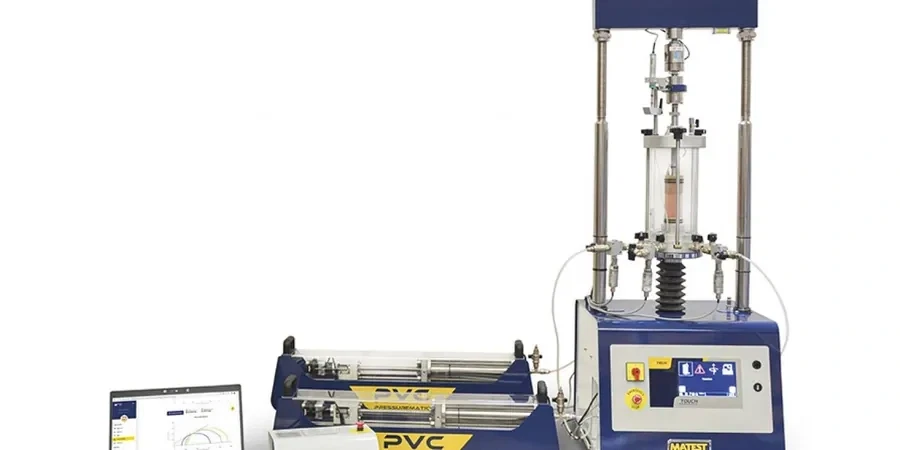
Our triaxial testing program in Hialeah is designed to provide the exact parameters your design requires—no generic reports.
Effective Stress Triaxial (CU with u)
Consolidated-undrained test with pore water pressure measurement: we back-pressure saturate to a Skempton B value of at least 0.95, consolidate under three effective confining stresses, and shear undrained at 0.01 in/min. The output includes Mohr-Coulomb c' and φ', stress path, and the A-factor at failure.
Total Stress Triaxial (UU)
Unconsolidated-undrained test for short-term stability in fine-grained soils: three specimens are tested at different cell pressures without saturation or consolidation. This provides undrained shear strength Su for bearing capacity and lateral earth pressure calculations in Hialeah clay layers.
Common questions
What is the typical turnaround for a triaxial test set in Hialeah?
A standard set of three specimens—either UU or CU with pore pressure—is typically completed within 7 to 10 business days from sample receipt. Consolidated-drained tests take longer due to the slow shear phase and usually require 14 to 18 business days. Rush orders can be accommodated for an additional fee; please call the lab before shipping samples to verify the current queue.
How much does a triaxial test program cost?
A three-specimen UU set costs between US$2,100 and US$2,410. A CU with pore pressure set on three specimens falls within the same range, US$2,100 to US$2,410, depending on the complexity of consolidation stresses and reporting needs. We provide a firm quote after reviewing the project's loading scenario and sample condition.
What soil conditions in Hialeah make triaxial testing necessary?
Hialeah's subsurface consists of alternating Miami Limestone, calcareous sand, and soft marl—materials where drained and undrained behavior differ significantly. For projects involving deep excavations, canal-front retaining walls, or mat foundations on variable strata, triaxial testing is essential to obtain c and phi parameters that reflect the actual failure envelope, rather than relying solely on SPT correlations.
Can you test remolded or compacted samples from Hialeah fill?
Yes. We prepare remolded specimens at specified moisture and density—typically 95% of modified Proctor maximum per ASTM D1557—and perform triaxial tests under the required drainage condition. This is common for verifying engineered fill on Hialeah commercial sites where imported material is placed beneath structural slabs.
What reporting deliverables do you provide with triaxial results?
Each report includes the Mohr-Coulomb failure envelope plot, deviator stress versus axial strain curves, excess pore pressure versus strain (for CU tests), secant modulus E50, and a summary table with c, φ, and failure criterion. We also provide the p-q stress path when requested for advanced constitutive modeling. More info.