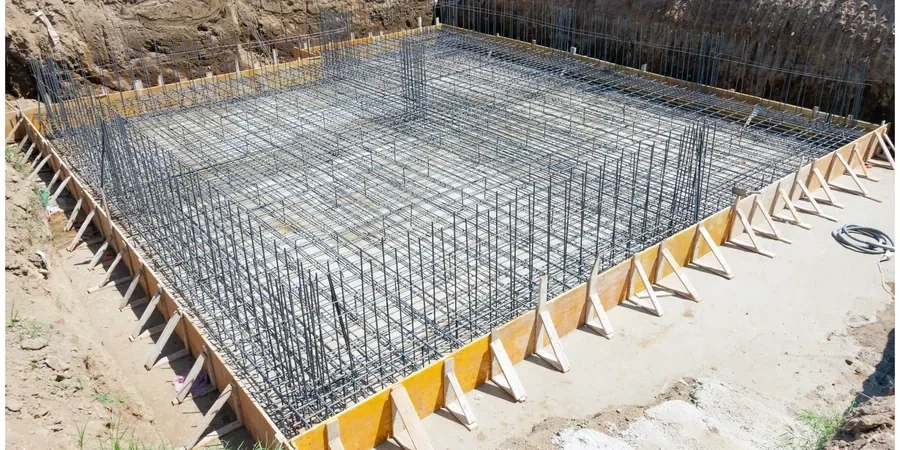
Hialeah sits on a shallow limestone caprock—Miami oolite—that barely hides the high groundwater table just a few feet below the surface. Anyone who has broken ground near Amelia Earhart Park knows the drill: excavate three feet and you hit either rock or water, sometimes both on the same lot. A conventional spread footing rarely works uniformly across a site here, which is why raft/mat foundation design paired with SPT drilling becomes the practical starting point for multi-story residential and warehouse projects. The mat slab bridges minor dissolution cavities and soft lenses in the oolite, distributing column loads over a larger footprint and keeping differential settlement within the IBC Chapter 18 serviceability limits. In Hialeah, that means the difference between a slab that stays flush with the floor finishes and one that cracks within the first rainy season.
A well-designed mat foundation in Hialeah turns the high water table from a liability into a uniform support condition—if the subgrade modulus is calibrated to actual CPT data, not textbook tables.
Scope of work in Hialeah
Procedure video
Typical technical challenges in Hialeah
Since the 1960s, Hialeah's building surge involved filling countless marshy depressions and solution channels with loose silty sand and debris, often without proper records. The primary concern for a mat foundation in this area isn't the limestone itself but undocumented fill pockets that borings fail to detect. A slab bridging a ten-foot-wide dissolution feature may perform adequately under dead loads, yet it could tilt under peak live loads during a hurricane shelter event, especially if the water table falls and the fill compresses. This risk prompted the ASCE 7-22 risk category upgrades for critical structures. The engineering solution involves a boring grid spaced no more than fifty feet apart, supplemented by ground-penetrating radar or electrical resistivity surveys to identify hidden anomalies before finalizing the mat reinforcement. In Hialeah, omitting geophysical testing means gambling the foundation on what the driller saw rather than what they overlooked.
Our services
For projects in Hialeah, mat foundation packages encompass the complete structural and geotechnical work required for Miami-Dade permit submissions.
Mat Slab Structural Design & Detailing
A finite element model of the reinforced concrete mat uses spring supports calibrated to site-specific CPT and SPT data. It evaluates punching shear at columns, buoyancy resistance for the seasonal high water table, and rebar schedules following ACI 318-19.
Subgrade Investigation & Modulus Calibration
CPT soundings and SPT borings across the building footprint are processed to create a layered subgrade reaction modulus map. This approach avoids the conservative assumption of uniform soil stiffness, which could unnecessarily double the mat thickness.
Construction-Phase Monitoring for Mats
Settlement plates and piezometers are placed before pouring the mud slab, with weekly readings taken throughout the superstructure erection. Early-warning levels are linked to the project's angular distortion limit, allowing the contractor to adjust sequencing before cracks develop.
Common questions
What does raft/mat foundation design cost for a Hialeah building?
For a standard residential or light commercial building in Hialeah, the combined geotechnical investigation and mat structural design package costs between US$980 and US$3,720. The variation depends on the number of borings or CPT soundings required by Miami-Dade County and the complexity of the column layout. A larger warehouse with heavy rack loads and a mezzanine falls at the higher end because the finite element modeling and punching shear checks demand more engineering hours.
How do you handle the high groundwater when designing a mat foundation in Hialeah?
The seasonal high water table—often three to five feet below grade in central Hialeah—is considered a permanent design condition. The mat is verified for buoyancy under a fully flooded scenario per ASCE 7-22 flood provisions, and the subgrade modulus is reduced to account for lost effective stress in the upper limestone. Perimeter edge beams are deepened to add dead weight where uplift margins are slim.
Is a mat foundation better than deep piles for Hialeah's limestone?
The choice depends on oolite quality and column loads. When SPT N-values exceed 25 in competent limestone with minor dissolution features, a mat slab is often quicker and cheaper than driving piles through vuggy rock. However, if borings reveal continuous cavities or a thick layer of loose fill over the caprock, a piled foundation may be necessary. The decision relies on settlement analysis, not a rule of thumb.
What building types in Hialeah most often use a raft foundation?
Four-to-six-story apartment buildings, self-storage facilities, and tilt-up warehouses are the primary Hialeah projects utilizing mat foundations. These structures have moderate column loads—typically under 400 kips—allowing the mat to spread pressure over enough area to stay below Miami-Dade's presumptive bearing values without requiring deep foundations.
How long does the design and approval process take in Hialeah?
After completing the subsurface exploration, the mat design and drawing package takes approximately three to four weeks. Miami-Dade building department review adds another two to four weeks, depending on whether the project requires a peer review for the foundation. Expedited review is available for smaller structures under 5,000 square feet.