To mitigate risks such as excessive settlement, bearing capacity failure, and liquefaction in Hialeah, a range of specialized geotechnical techniques—including deep dynamic compaction, vibro-replacement, rigid inclusions, and chemical grouting—are employed. These methods are not optional enhancements but essential prerequisites for durable construction in a city with challenging subsurface conditions. By investing in proper ground improvement, developers and public agencies in Hialeah directly benefit from extended infrastructure lifespan, reduced maintenance costs, and adherence to stringent building codes. The core purpose is to safely enhance the engineering properties of soil and fill materials to support structural loads.
In Hialeah, the water table sits typically two to four feet below the surface, heightening difficulties posed by loose granular soils. The subsurface exhibits a classic South Florida profile: a thin layer of organic topsoil underlain by loose to medium-dense quartz sands, frequently interbedded with soft limestone and organic silt. This hydrogeologic setting fosters hydrocompaction and liquefaction even during modest seismic events. Moreover, shallow porous limestone can cause irregular bearing conditions and possible sinkhole activity. Consequently, a thorough geotechnical investigation is the bedrock of any effective ground improvement design in the area.
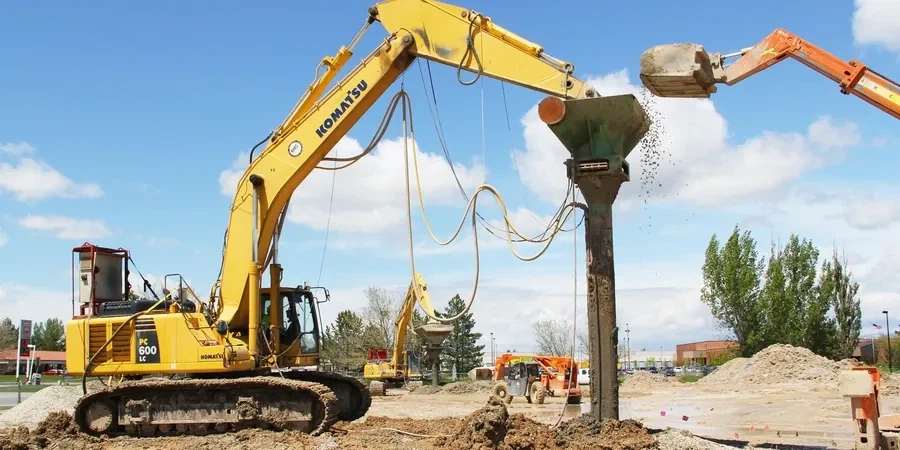
Regulatory compliance in Hialeah is governed by the Florida Building Code (FBC) 8th Edition (2023), which incorporates the International Building Code with state-specific amendments. Chapter 18 of the FBC outlines requirements for soils and foundations, mandating geotechnical reports for most commercial and multi-family structures. Crucially, the code references the American Society of Civil Engineers (ASCE) 7 standard for seismic design, requiring site-specific ground motion analyses that often necessitate ground improvement to meet Site Class D or E criteria. Additionally, Miami-Dade County's environmental regulations impose strict controls on dewatering and vibration, directly influencing the selection of techniques like stone column design to minimize off-site impacts.
Ground improvement in Hialeah is required by a wide array of projects, mirroring the city's mix of industrial, commercial, and residential uses. For instance, single-family home additions on poorly compacted fill may utilize shallow compaction grouting to stop ongoing settlement. Mid-rise condominium developments along Palm Avenue rely on vibro-compaction to densify sands and avoid differential settlement that could cause cracks in partition walls. Large-span warehouse and logistics centers adjacent to the Hialeah Park Racing & Casino demand floor slabs with millimeter-level flatness tolerances, often met by installing rigid inclusions beneath the slab-on-grade. Critical infrastructure like water treatment plant expansions and bridge approaches for the Palmetto Expressway commonly employs deep soil mixing to produce stiff, impermeable soil-cement blocks that counteract scour and lateral spreading.
Available services
Common questions
What is the primary purpose of ground improvement in construction?
By modifying the physical properties of soil, ground improvement enhances bearing capacity, lessens settlement, and lowers liquefaction hazard. This process turns weak or compressible ground into a robust material that can safely bear structural loads, thus averting structural distress and prolonging the lifespan of foundations and pavements.
How does the high water table in Hialeah affect ground improvement method selection?
In Hialeah, vibro-replacement and stone columns are frequently chosen because they densify and displace soil without needing dry conditions, avoiding complications from the shallow groundwater. This high water table makes dewatering-dependent techniques difficult and can lead to borehole instability. Additionally, any pumping and treatment of discharge water must comply with stringent environmental permits from Miami-Dade County.
Which Florida Building Code sections directly govern ground improvement work?
To attain acceptable Site Class C or D parameters under ASCE 7 (referenced in Chapter 16 of the Florida Building Code), ground improvement is often necessary. Chapter 18 governs soils and foundations, mandating a geotechnical investigation for most structures, while Section 1803.5.3 specifically requires evaluation of liquefaction potential.
What are the signs that a Hialeah construction site might need ground improvement?
Potential issues are signaled by visible ground cracks in nearby structures or a history of filled land. Additional key indicators are loose sandy soils with low Standard Penetration Test blow counts (N-values under 15), organic silt or peat layers, a water table shallower than five feet, and a geotechnical report forecasting total settlement more than one inch.