Hialeah’s growth from a 1920s land boom frontier into one of Florida’s densest cities placed heavy demand on its pavement infrastructure. The underlying Miami Limestone formation, often capped by thin layers of silty sand and organic muck, creates a subgrade that is anything but uniform. When we run a laboratory CBR test on samples taken from a project site near the Okeechobee Road corridor, we are essentially quantifying how much punishment that soil can take before it deforms under repeated traffic loads. The California Bearing Ratio, soaked for four days to replicate the local water table sitting barely a meter below grade, gives us a number that directly feeds into AASHTO 1993 pavement thickness design. Without this number, any asphalt or concrete section specified for a Hialeah arterial is just guesswork. For deeper stratigraphy correlation, we often pair the CBR with in-situ permeability testing when drainage layers are planned above the limestone cap.
A soaked CBR value below 3% in Hialeah’s marl pockets means you are not designing a pavement, you are designing a future pothole.
Scope of work in Hialeah
Typical technical challenges in Hialeah
Hialeah sits on a flat coastal plain where the Biscayne Aquifer is just a few feet down, and summer storms can drop eight inches of rain in a single afternoon. That combination makes soaked CBR the only number worth looking at—unsoaked values are academic exercises that do not represent the saturated condition the subgrade will live in for half the year. A pavement section designed on an unsoaked CBR of 15% that drops to 2% when saturated will rut within two rainy seasons. We have measured CBR reductions of over 70% between as-compacted and soaked conditions in the silty sands found east of Palm Avenue. The risk is not just rutting; it is complete base-course contamination as fines pump up through the aggregate under cyclic loading. The IBC references AASHTO pavement design methodology that ties structural number directly to CBR, so a wrong assumption propagates through the entire section. When the subgrade shows sensitivity to moisture, we recommend a CBR road assessment to verify the design value with field conditions before the paver ever shows up on site.
Our services
The CBR testing done at our Hialeah facility is part of the comprehensive geotechnical analysis necessary for designing pavements in Miami-Dade County. Each test package is customized to address the unique subgrade conditions encountered at the site.
Soaked Laboratory CBR with Swell Potential
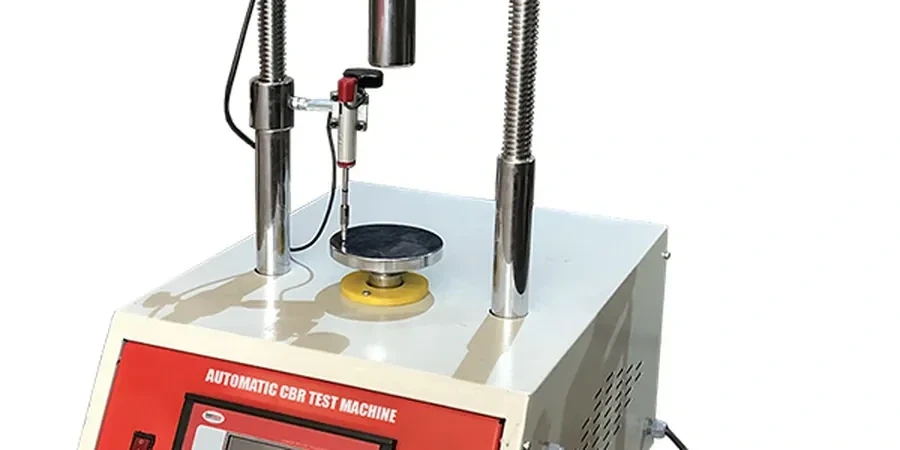
The four-day submerged CBR test adheres to ASTM D1883, conducted on remolded samples compacted to the desired density. Dial readings for swell are taken every 24 hours, a surcharge is applied to mimic pavement weight, and stress-penetration curves are generated for both corrected and uncorrected values.
CBR Correlation with Field Density and Proctor
A combined laboratory package offers the modified Proctor test (ASTM D1557) for establishing moisture-density relationships along with CBR testing at various compaction levels. This yields a strength-versus-density curve, enabling the contractor to refine field compaction targets based on the CBR achievable in Hialeah’s varied fill materials.
Common questions
What is the cost of a laboratory CBR test in Hialeah?
The price for a standard laboratory CBR test, which includes modified Proctor compaction and the four-day soaked procedure per ASTM D1883, falls between $120 and $190 per sample. The final cost depends on whether testing is performed at a single compaction point or a three-point curve is used to determine CBR versus density relationships.
Why is the soaked CBR value more important than unsoaked for a Hialeah pavement?
Hialeah has extremely shallow groundwater, typically three to five feet below the surface, and the region sees over 60 inches of rain each year. Consequently, the subgrade under any pavement will eventually become saturated. The 96-hour soak in the ASTM D1883 procedure replicates this worst-case scenario, providing a CBR value that remains reliable over the design life, rather than a misleading dry-strength number that would drop after the first wet season.
How do you correlate laboratory CBR with the limestone rock found under Hialeah?
Laboratory CBR testing is intended for soil subgrades, not hard rock. Where the Miami Oolite limestone is close to the surface, we do not perform CBR on the rock itself—that would give unrealistically high results. Instead, we record the rock quality designation (RQD) and conduct unconfined compression tests on the limestone, while reserving CBR for the overlying sand, marl, and fill layers that actually govern pavement performance. The pavement section is then designed with a stiff rock layer at depth and a CBR-characterized soil cushion above.