Hialeah's flat topography can be deceiving. Even minor excavations or embankment fills require a thorough slope stability analysis under IBC Chapter 18 and ASCE 7-22. The city sits on a limestone ridge with pockets of organic peat and loose sands that complicate any cut operation. Our lab runs direct shear and triaxial tests to feed Spencer and Morgenstern-Price models, giving you a factor of safety that accounts for rapid drawdown after a tropical storm. Before breaking ground near the Miami Canal or the Gratigny Expressway, we often combine this with an SPT drilling program to map the depth to the Fort Thompson Formation, ensuring your retaining structures won't slip along a weak organic lens.
A 1.5 factor of safety isn't a checkbox—it's the difference between a dry parking lot and a lawsuit after the first hurricane season.
Scope of work in Hialeah
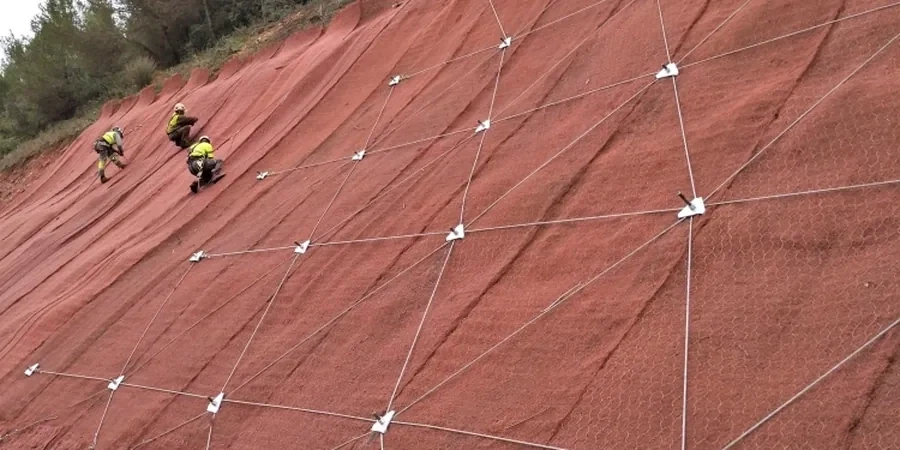
Procedure video
Typical technical challenges in Hialeah
The eastern part of Hialeah rests on elevated limestone pinnacles; conversely, the zone west of Palm Avenue transitions into the former Everglades boundary, where organic matter can reach up to 15%. This contrast is pivotal. A 2:1 slope that remains stable in the east may undergo creep or rotational failure in the west within half a year of becoming saturated. Toe failures have been observed in retention basins near Amelia Earhart Park, attributed to the designer's assumption of a uniform sandy fill. Our report delineates these subsurface variations and computes time-dependent pore pressure dissipation, enabling decisions on whether to reduce slope angle, add a toe drain, or apply geogrid reinforcement. Overlooking the lateral variation across Hialeah's districts is the most frequent error we rectify during peer reviews.
Our services
For projects in Hialeah, every slope stability package we provide encompasses three essential technical services:
Geotechnical Laboratory Testing
We perform CU triaxial and direct shear tests on Shelby tube samples obtained from your location to ascertain the effective friction angle and cohesion intercept required for limit equilibrium modeling.
Limit Equilibrium Modeling
Employing the Spencer and Morgenstern-Price methods, we evaluate circular and block failure surfaces under static, seismic, and rapid drawdown conditions in accordance with Miami-Dade Public Works specifications.
Reinforcement & Remediation Design
If the factor of safety falls below 1.5, we create geogrid arrangements, soil nail configurations, or slope regrading designs that comply with IBC and FDOT standards.
Common questions
What triggers a mandatory slope stability review in Hialeah?
Under IBC Section 1803.5, a stability analysis is mandatory for any permanent cut or fill that is steeper than 1.5H:1V and exceeds six feet in height. Additionally, the Hialeah Building Department mandates a review when an excavation lies within 50 feet of a public right-of-way or a canal.
How much does a slope stability analysis cost for a typical Hialeah commercial lot?
The cost of slope stability analysis for a typical commercial lot falls between US$1.070 and US$4.000, based on the number of cross-sections examined, necessary laboratory testing, and whether seismic scenarios must be modeled.
Do you need soil borings before the analysis?
Indeed, stratigraphic data from SPT borings or CPT soundings is required to construct the soil profile. If the depth to limestone or the organic layer thickness remains unknown, the slip surface analysis becomes unreliable.
Can you model the effect of the high water table in Hialeah?
Certainly. We incorporate a phreatic surface obtained from your monitoring wells or historical USGS records for the Biscayne Aquifer. Subsequently, the model determines pore-water pressure along the slip surface—frequently the dominant factor in Hialeah's water-saturated soils.