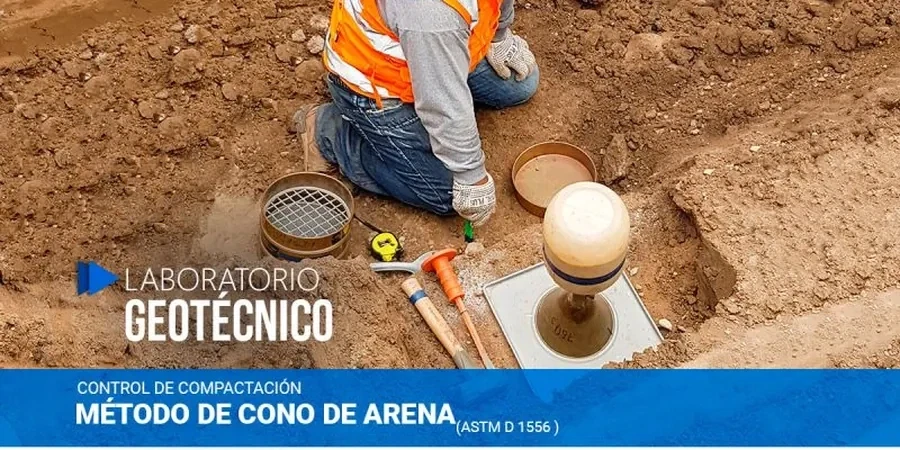
Hialeah sits on a thin veneer of sandy soils and fill over the Miami Limestone formation, where the water table often sits just three to five feet below the surface. That shallow groundwater, combined with the city's flat topography at roughly seven feet above sea level, makes fill placement and compaction control a daily challenge for any earthwork contractor. We have seen pads pass visual inspection only to settle six inches after the first summer rains because the density never reached the specified 98% of modified Proctor. The sand cone method per ASTM D1556 remains the most practical field verification tool for these conditions. It gives us a direct, volumetric measurement of in-place density that nuclear gauges can misread in the calcareous, shell-rich sands common across northwest Miami-Dade County. For deeper subgrade evaluation, we often pair the sand cone with an SPT drilling program to confirm bearing capacity below the compacted layer, especially where old agricultural fill or undocumented debris lenses are suspected.
A sand cone test done right on a Hialeah pad tells you more about future settlement risk than a dozen nuclear gauge readings taken on the same lift.
Scope of work in Hialeah
Typical technical challenges in Hialeah
In Hialeah, the subtropical wet-dry cycle accelerates the degradation of under-compacted fill more quickly than in virtually any other part of Florida's geology. During the period from May to October, daily thunderstorms soak the ground surface, and the water cannot percolate because the underlying limestone acts as a confined aquifer with minimal vertical drainage. On commercial pads that were only three years old, we excavated test pits and discovered that the bottom lifts still had less than 90% of maximum dry density; this was due to the contractor having hurried the earthwork during the rainy season and the inspector failing to perform sand cone tests on the lower lifts. Differential settlement is the typical failure mode: cracks appear in the slab along column lines, and the parking lot asphalt exhibits heaving and ponding. The cost of a single sand cone test is much lower than that of a saw-cut repair, and the resulting data becomes part of the permanent earthwork record required by the Hialeah building department under Florida Building Code Chapter 18.
Our services
The field density testing we conduct in Hialeah encompasses the entire process, starting with pre-construction proof-rolling and continuing through to final acceptance testing. Each report contains the GPS coordinates of the test location, the lift number, and a reference to the compaction curve, enabling the geotechnical engineer of record to examine the data without having to search for paperwork.
Fill Compaction Verification
To confirm that building pads, utility trenches, and retaining wall backfill achieve 95-98% modified Proctor density, sand cone tests are conducted at either one test per 2,500 square feet per lift or at the frequency specified in the project's geotechnical report.
Base Course Acceptance Testing
Before asphalt or concrete paving, density testing is carried out on limerock and crushed concrete base courses. The grading crew receives instant moisture correction feedback to ensure they remain within the specified optimum range.
Troubleshooting & Forensic Density Checks
When settlement or cracking occurs, suspect areas are retested. This involves correlating results with lab Proctor curves on the actual fill material to ascertain whether the issue stems from the material itself or from insufficient compaction effort.
Common questions
How much does a sand cone density test cost on a Hialeah job site?
In Hialeah, the cost of a sand cone field density test usually ranges from US$100 to US$160 per test. Factors influencing the price include the quantity of tests per mobilization, the travel distance from our field base, and whether the scope incorporates a one-point Proctor check on the same material. Our flat-rate quote encompasses the technician, calibrated sand, field equipment, and the signed report.
Why use the sand cone instead of a nuclear density gauge in Hialeah?
Nuclear gauge readings can be inaccurate in Hialeah due to the prevalence of calcareous sands and oolite limestone; their calcium carbonate mineralogy alters neutron moderation and gamma backscatter compared to silica-based reference standards. Unlike nuclear gauges, the sand cone test provides a direct volumetric measurement independent of soil chemistry, thereby eliminating the calibration bias that may arise in Miami-Dade soils. Additionally, it is easier to employ in narrow trenches and near utilities, where a gauge operator would have to establish radiation boundaries.
At what point during earthwork should the sand cone test be performed?
Immediately after the sheepsfoot or smooth-drum roller completes its passes on the current lift, and before the next lift is placed, the test must be conducted. If rain is expected within the hour in Hialeah's climate, we perform the test at once, as a sudden downpour could increase the moisture content of the top of the lift by two to three percent, rendering the density reading invalid. Typically, the building department inspector wishes to observe at least part of the tests on structural fill; therefore, we coordinate the timetable with both the grading foreman and the inspector.