In Hialeah, the wet season doesn't just slow down earthwork — it can completely change the compaction curve of a fill material in a single afternoon. With average annual rainfall exceeding 60 inches and a shallow water table sitting just a few feet below the surface across much of the city, moisture control during fill placement isn't a minor detail; it's the difference between a slab that settles and one that holds. The Proctor test establishes the moisture-density relationship that field crews rely on to hit spec. Whether it's Standard Proctor for landscaping subgrade off West 68th Street or Modified Proctor for heavy truck aprons near the Hialeah Park industrial zone, the lab curve sets the target. We run both ASTM D698 and D1557 procedures in our Hialeah facility, using locally sourced fill from borrow pits around northwest Miami-Dade so the reference curve matches what actually goes under the compactor. For projects where fill is being placed over porous Miami Limestone, pairing the Proctor with a sand cone density test in the field gives the QA/QC team a complete picture of achieved compaction.
The Proctor curve isn't just a lab number — it's the moisture window that a compactor operator chases all day under the Hialeah sun.
Scope of work in Hialeah
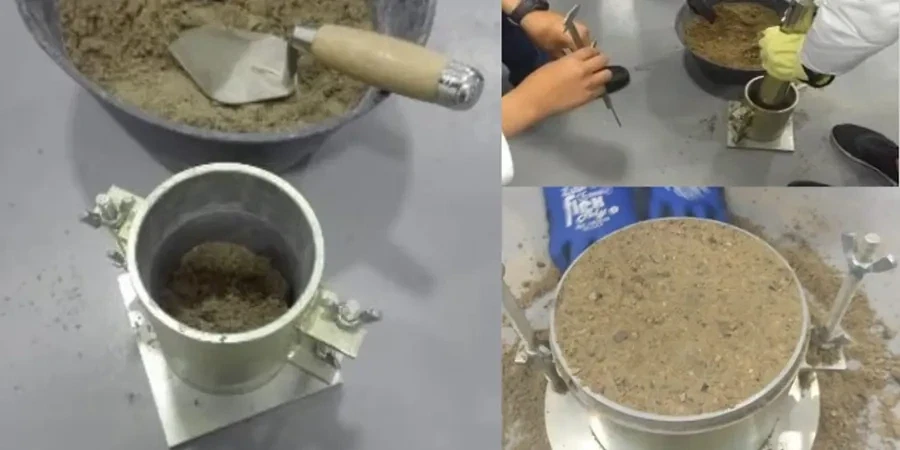
Typical technical challenges in Hialeah
The most common mistake in Hialeah earthwork is using a Proctor curve from the wrong material. A contractor pulls a sample from the stockpile on Monday, gets a Modified Proctor curve, and then the fill delivery changes on Wednesday — different pit, different fines percentage, completely different optimum moisture. The field density test passes because the technician is referencing the wrong curve, and six months later the slab shows differential settlement. Another frequent issue: compacting fill above optimum moisture during the summer rainy season. Hialeah's afternoon thunderstorms can spike the moisture content of a windrowed fill in under an hour, and if the operator doesn't adjust, the compacted lift traps excess pore pressure that never fully dissipates. The lab can catch this by running check Proctors on changed materials and flagging moisture sensitivity, but only if the testing frequency matches the variability of the fill source. For deep fill sections, combining the Proctor baseline with in-situ permeability testing helps anticipate drainage behavior in the compacted mass.
Our services
We provide two levels of compaction testing for Hialeah projects, selected based on the structural load and the specification requirements.
Standard Proctor (ASTM D698)
Used for landscape fill, residential slab subgrade, and utility trench backfill where compaction is done with walk-behind rollers or vibratory plates. The 12,400 ft-lbf/ft³ effort simulates moderate compaction equipment.
Modified Proctor (ASTM D1557)
Specified for commercial building pads, roadway base, and industrial pavements in Hialeah. The 56,000 ft-lbf/ft³ effort matches the higher energy of modern heavy rollers and provides a denser reference target.
Common questions
What does a Proctor test cost in Hialeah?
A single-point Proctor (Standard or Modified) typically runs between $100 and $230, depending on whether the material requires the 4-inch or 6-inch mold and whether oversize corrections are needed. Volume pricing applies for multi-sample projects.
How many Proctor curves do I need for my Hialeah job?
One Proctor curve per distinct fill material. If you're importing fill from two different borrow pits, or if on-site cut material will be reused, you need separate curves for each. When the material changes visually or the source switches, a new Proctor is required to keep field density testing valid.
How long does the lab take to deliver a Proctor result?
Standard turnaround is 24 to 48 hours after the sample arrives at the lab. Rush service is available for same-day results if the material is received before noon, which helps when earthwork is on hold waiting for the compaction target.