In Hialeah, any excavation deeper than 12 feet triggers IBC Section 3304 requirements for protective systems, but the real challenge starts earlier—with the groundwater. The Biscayne Aquifer sits barely 4 to 6 feet below surface across most of the city, and ignoring it during a deep excavation design phase leads straight to blowouts, base instability, and costly delays. Our team runs the analysis under ASCE 7-22 load combinations, factors in the layered Fort Thompson Formation limestone, and models dewatering drawdown before a single bucket hits the soil. For projects near the Miami Canal or within the Leah Arts District redevelopment zone, we also tie in excavation monitoring from day one—inclinometers and piezometers give real-time feedback on shoring deflection and pore pressure, which matters when adjacent structures sit on shallow footings from the 1960s.
In Hialeah, groundwater controls the excavation design. Dewatering is not an add-on—it is the starting point.
Scope of work in Hialeah
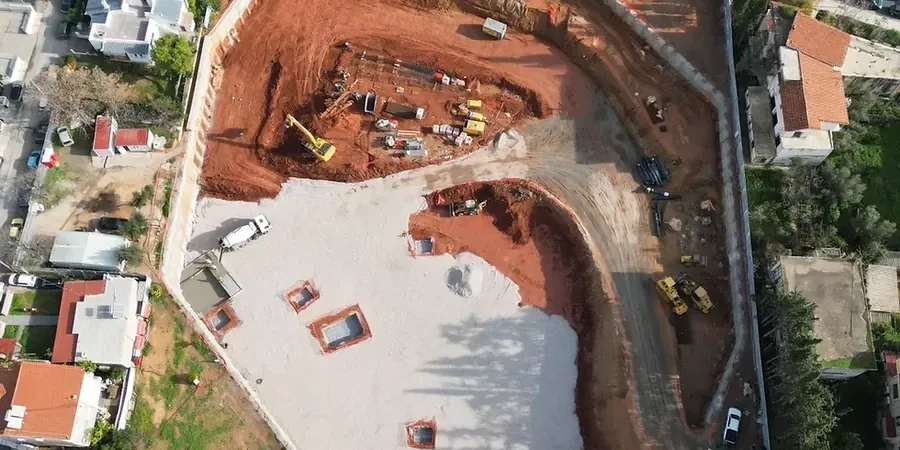
Typical technical challenges in Hialeah
The construction boom in Hialeah following the 1920s land rush led to many buildings erected from that era through the 1970s on shallow strip footings without any prior geotechnical investigation. Nowadays, when a neighboring excavation reaches a depth of 20 feet, those structures can't handle even minimal angular distortion. Instances have occurred where settlement triggered by dewatering cracked a concrete block structure two lots away—the influence zone extended farther than anticipated because a hidden paleo-channel connected different strata. Another quiet hazard in deep excavations here is base heave. In the marl deposits common north of 49th Street, the excavation floor can heave within a few hours of unloading if the dewatering system doesn't account for a trapped water lens. Our standard approach incorporates a pumping test before excavation begins and a heave evaluation using Terzaghi's method with undrained strength parameters derived from Shelby tube samples—never relying solely on SPT blow counts.
Our services
Groundwater issues are inherent to every sizable excavation in Hialeah. Our design submissions integrate three interconnected components—structural shoring, dewatering, and movement monitoring—delivering a unified package to the contractor rather than three separate, uncoordinated documents.
Shoring System Design
Shoring systems such as soldier pile and lagging, secant piles, or soil nail walls are designed specifically for Hialeah's limestone and marl stratigraphy. These solutions optimize tieback spacing and incorporate waler design according to AISC 360 standards.
Construction Dewatering Plans
We develop layouts for deep wells and wellpoints, including drawdown analysis. The specifications cover pumping tests and discharge volume calculations to meet SFWMD regulatory requirements.
Geotechnical Instrumentation & Monitoring
Instrumentation plans include inclinometer casings, settlement monitoring points, and vibrating wire piezometers, all with initial baseline measurements and alarm thresholds linked to the project-specific settlement and movement tolerances.
Common questions
What depth triggers a shoring design requirement in Hialeah?
According to the 2021 International Building Code, any excavation exceeding 5 feet in depth mandates protective systems unless entirely in stable rock. In Hialeah, the surface sand and weathered limestone seldom meet the regulatory definition of stable rock, so we design shoring for essentially every cut more than 5 feet deep. Under OSHA 1926 Subpart P, most soils here are categorized as Type C, which demands the most conservative sloping or shielding measures.
How do you handle the high groundwater during excavation?
The Biscayne Aquifer lies close to the surface throughout Hialeah. We engineer active dewatering installations, typically using deep wells at 20- to 40-foot intervals, with pump capacities determined from in-situ pumping tests that measure the hydraulic conductivity. The objective is to lower the water table a minimum of 3 feet beneath the excavation floor prior to any digging and to maintain that level for the duration of construction.
What does a deep excavation design cost in Hialeah?
The cost for deep excavation design services in Hialeah varies between US$1,990 for a straightforward retaining wall on a single-family lot and US$9,200 for a complicated commercial project involving tiebacks, dewatering simulations, and instrumentation plans. The final fee depends on excavation depth, the building's proximity to neighboring structures, and the necessary degree of hydrogeological analysis.
Can you design an excavation support system for a site next to a canal?
Absolutely. Excavations next to canals present two added challenges: a fixed hydraulic head boundary and possible seepage beneath the shoring wall. We analyze flow nets corresponding to the actual canal water level and perform stability calculations that incorporate seepage forces. Typically, the remedy involves installing a deeper cutoff wall or a series of relief wells positioned between the excavation and the canal to control pore pressures at the toe.